All case studies
Case study · Banking & Enterprise
Enterprise B2B · Portal Design · Research

One portal. Three user types. One manual process eliminated.

Intellicorp's drug screening process required staff to physically visit clinics to collect payment and results. Applicants had no self-service path. Employers had no visibility. The solution was a portal that consolidated information entry, appointment scheduling, and payment into a single flow — and eliminated the operational overhead entirely.

3 Distinct user types
0 Manual clinic visits needed
01 — The situation

Intellicorp is a background screening investigation company. When they brought me on, their drug screening process was almost entirely manual — staff physically traveled to local clinics to collect payment and results. Applicants had no way to schedule appointments or submit their information online. Employers had no real-time visibility into where their applicants were in the process.

The problems were layered: an operational burden on Intellicorp, a friction-heavy experience for applicants, and a lack of transparency for employers who were waiting on results they couldn't track.

The opportunity was clear — but the solution needed to work for three very different user types simultaneously, each with distinct needs, mental models, and levels of technical comfort. Getting the portal wrong for any one of them would break the whole flow.
Client
Intellicorp — background screening investigation company
My role
Requirements gathering, user research, information architecture, user flows
Industry
Enterprise B2B · HR technology · Background screening
Users served
Applicants · Employers (clients) · Intellicorp case managers
Core problem
Manual clinic visits for payment collection · No self-service for applicants · No employer visibility
02 — Three users, one portal
01
Applicants
Individuals going through a drug screening as part of a job application or onboarding process. Primary needs: clarity on what's required, easy scheduling, and confidence that their information is secure.
02
Employers (Intellicorp clients)
HR teams and hiring managers who needed to track applicant progress, receive automated notifications on results, and manage multiple screening processes simultaneously without manual follow-up.
03
Intellicorp case managers
Internal staff who previously managed the process manually — scheduling, collecting payment, tracking results. The portal needed to streamline their workflow, not create new complexity for them.
03 — The process
01
In-person workshops to document the current state

Before designing anything, I needed to understand exactly how the process worked — and where it broke down. Through a series of in-person client workshops, I mapped the current user journeys for all three personas, reviewed existing user surveys, and gathered both business and user requirements.

The top requirements that emerged: automatically notify employers when results were submitted, optimize the applicant invitation and information entry flow, ensure submission security, and eliminate the manual clinic visit process entirely.

In-person workshops · Journey mapping · Requirements gathering
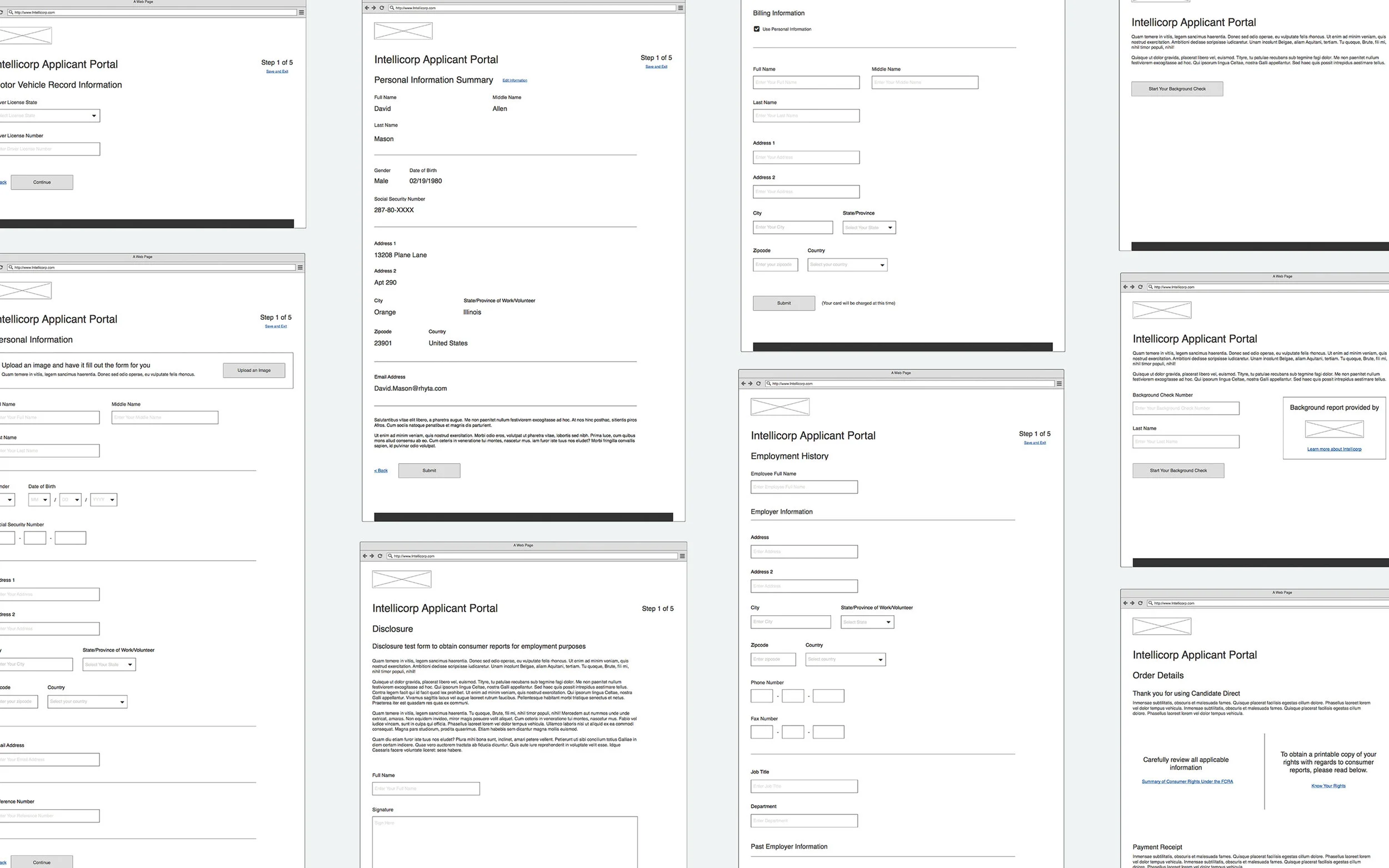
Intellicorp Applicant Portal — early wireframe explorations
Early wireframe explorations — mapping the applicant portal flow across all steps
02
User interviews, surveys, and persona refinement

To understand the people behind the process, I conducted user and stakeholder interviews across all three persona types. Once I had a directional understanding of their motivations and pain points, I followed up with an email survey to 20 respondents — getting detailed responses from 7 — to dig into the more nuanced elements of each persona's experience.

The research surfaced pain points that weren't visible in the process documentation: applicants who didn't understand why they were being screened, employers frustrated by a lack of status visibility, and case managers spending disproportionate time on simple follow-up tasks.

User interviews · Survey research · 3 personas defined
03
User flows that served as the development blueprint

Once the personas were defined, I mapped every scenario for each user type — how they entered the portal, what decisions they faced at each step, and what happened at the edges (incomplete submissions, scheduling conflicts, failed payments). These user flows weren't just design artifacts — they became the system documentation for back-end development.

A significant constraint was managing duplicate applicant records across multiple employers: the same applicant could be screened for different jobs simultaneously, requiring the portal to handle cross-employer data cleanly without creating confusion or privacy issues.

User flows · System documentation · Edge case mapping
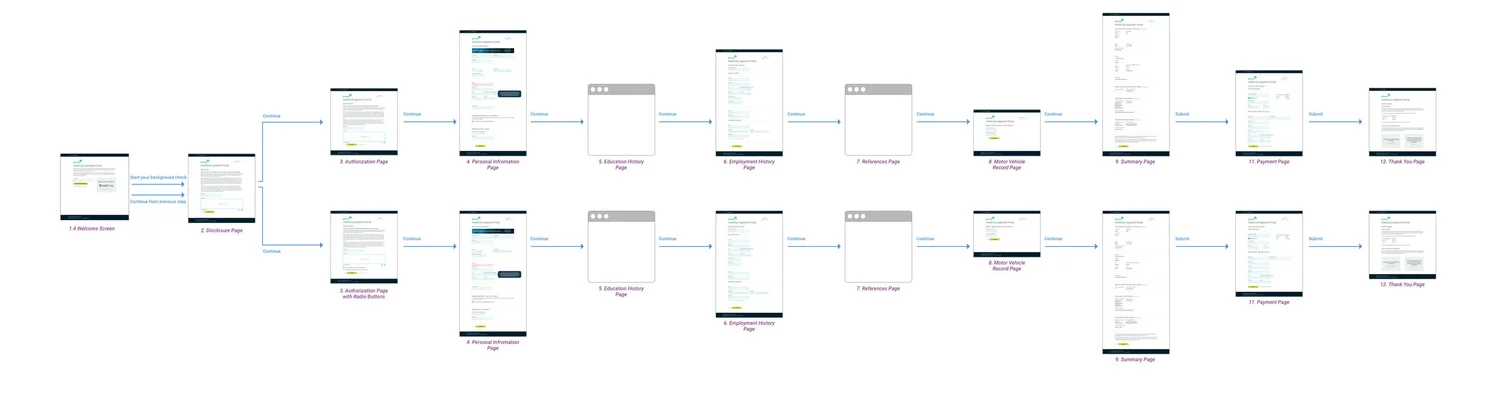
Intellicorp — full applicant user flow diagram
User flow — full applicant journey from welcome screen through payment, mapped for both authorization paths
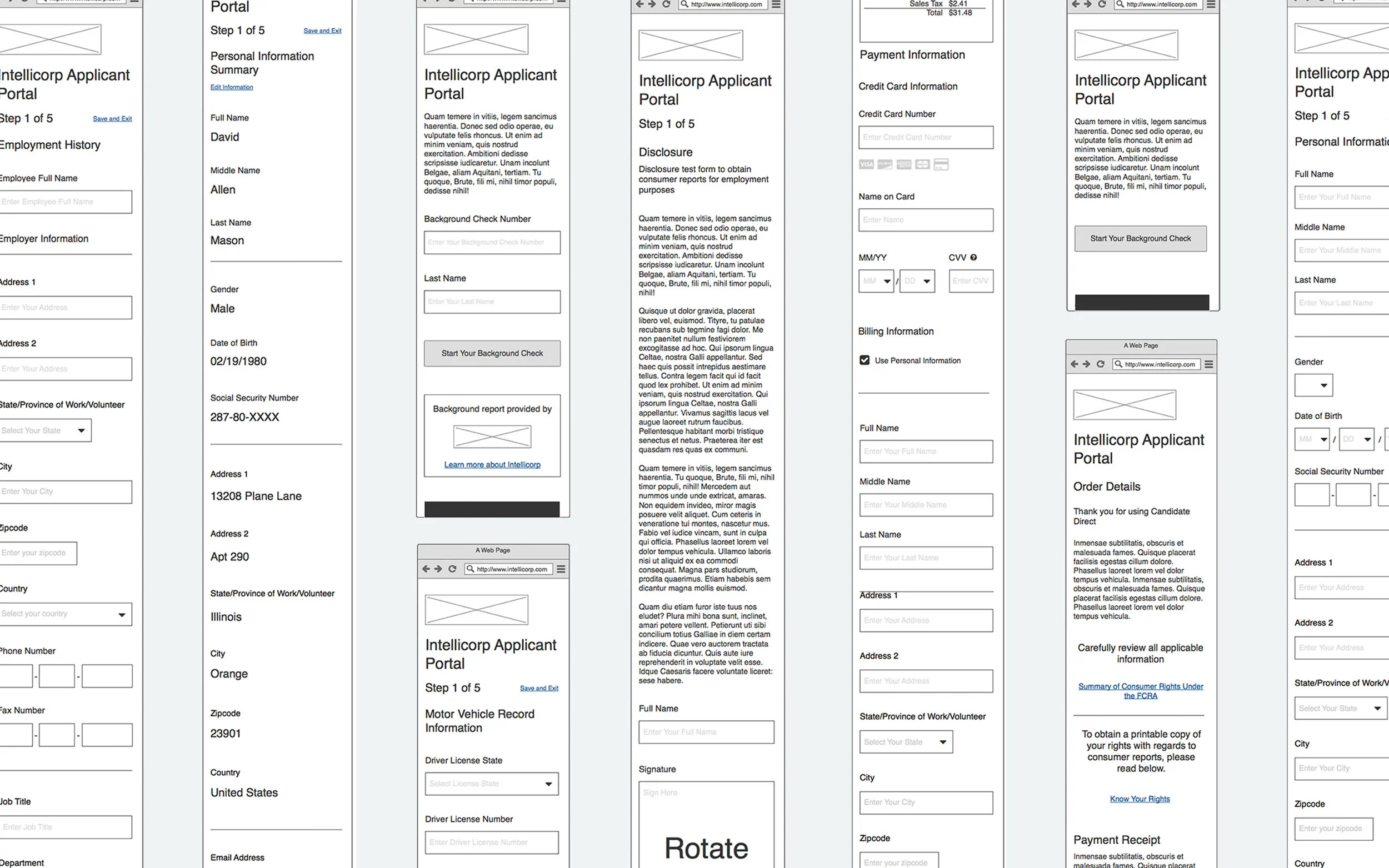
Intellicorp — desktop portal wireframes
Desktop wireframes — all portal steps across the applicant flow
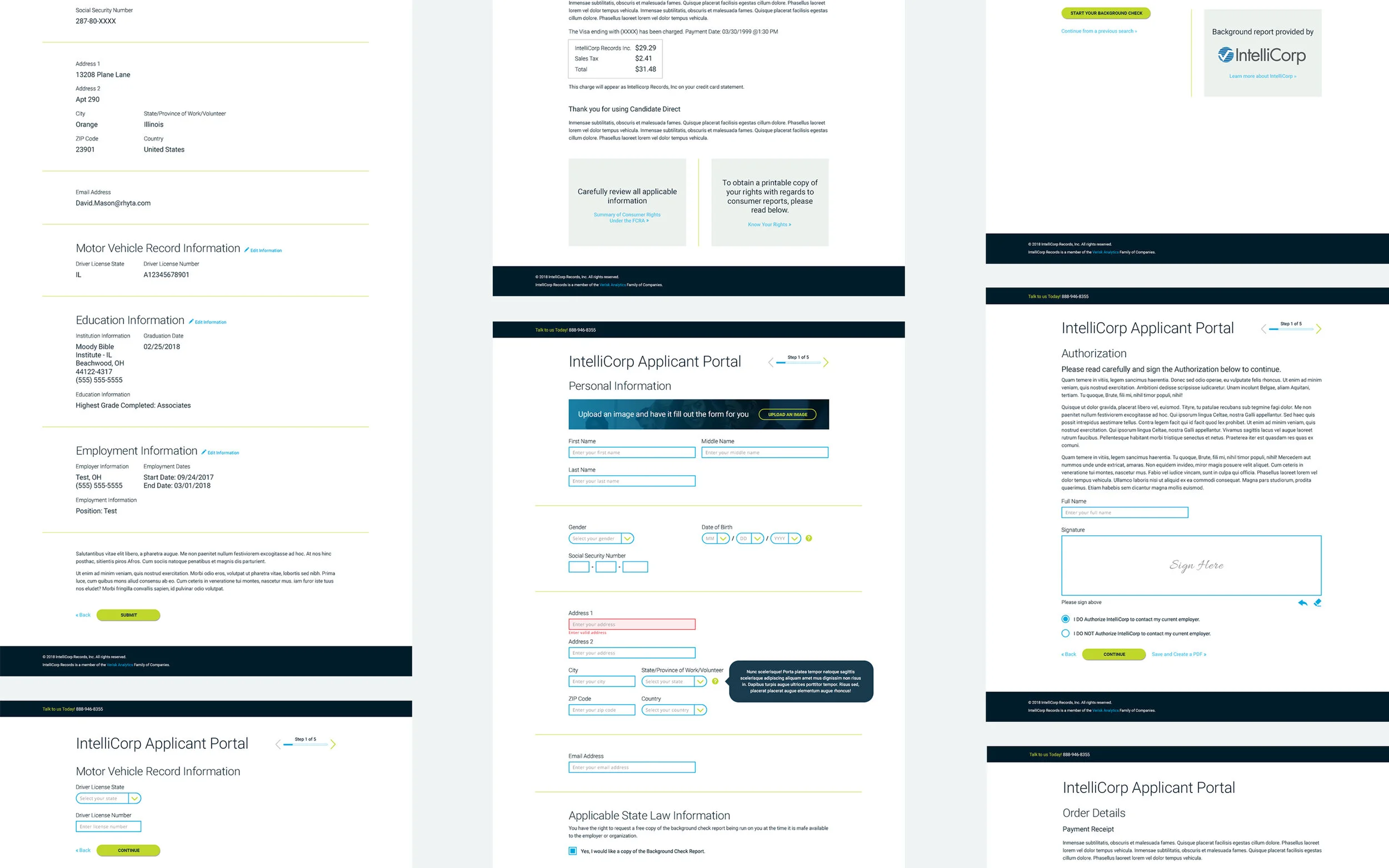
Intellicorp — final portal designs
Final designs — personal information, authorization, motor vehicle record, and payment screens

The UX problem was downstream of an operational one. Solving it for users meant eliminating a physical process that shouldn't have existed — and building a portal that served three very different user types simultaneously.

On the Intellicorp engagement

04 — Outcomes and impact
Eliminated manual clinic visits
Intellicorp staff no longer needed to physically travel to clinics to collect payment and results. The entire process moved online — saving time, reducing cost, and removing a human dependency from a process that didn't need one.
Applicant experience — dramatically improved
Applicants could now schedule appointments, enter their information, and pay — all in one place, at one time. What was previously a fragmented, unclear process became a single guided flow with clear status visibility throughout.
Employer notification automated
Employers received automatic notifications when applicant test results were submitted — eliminating manual follow-up and giving HR teams real-time visibility into a process they previously had to chase.
Applicants self-serve from invitation to result
The entire applicant journey — from invitation email through information entry, scheduling, and payment — became self-service. Intellicorp's case managers shifted from process facilitators to exception handlers.
The lasting thing

A process that required staff to physically visit clinics for payment and results now happens entirely within the portal — faster, with less overhead, and without manual follow-up.

Next case study
Five sprints, no title, millions in new business — Digital Realty