All case studies
Case study · Healthcare
Healthcare · Research · Persona Development

Millions of data points. Five people worth knowing.

Priority Health had access to the Claritas PRIZM dataset — one of the most detailed consumer segmentation tools available. The data existed. The challenge was turning it into something actionable. I analyzed the segments, validated the groupings through stakeholder interviews and in-person workshops, and translated it all into five personas with defined communication priorities for every channel.

5 Personas developed
3 Workshop formats
01 — The situation

Priority Health is a Michigan-based health insurance company with a large, varied member base. They had access to the Claritas PRIZM dataset — a segmentation tool that breaks the U.S. population into dozens of consumer segments based on demographics, behaviors, and lifestyle patterns. The data was rich. The problem was that no one knew what to do with it.

The engagement had three core challenges: analyze and group the PRIZM segments into personas that actually reflected Priority Health's audience, validate those groupings against real stakeholder and user perspective, and define how the organization should communicate with each group across their communication channels and digital platforms.

This wasn't about creating personas as a deliverable — it was about giving Priority Health a framework they could actually use to make decisions. Every workshop, every interview, and every synthesis session was pointed at that outcome.
Client
Priority Health — Michigan-based health insurance company
My role
Data analysis, persona development, stakeholder interviews, workshop facilitation
Deliverables
5 persona cards · Communication priorities · Empathy maps
Industry
Healthcare · Health insurance
02 — The process
01
PRIZM data review & analysis

The starting point was the data itself. Claritas PRIZM segments consumers into dozens of distinct groups — each with its own demographic profile, behavioral patterns, and lifestyle characteristics. I went through the full dataset, sorting the segment files and looking for natural groupings that made sense in the context of Priority Health's audience.

The goal wasn't to use every segment — it was to find the clusters that actually reflected who Priority Health was talking to. As I sorted and grouped, patterns started emerging: segments that shared similar attitudes toward healthcare, similar communication preferences, similar barriers to engagement. Those patterns became the foundation for five persona groupings.

This phase was largely independent work — deep in spreadsheets and segment documentation — before bringing any of it to stakeholders for validation.

PRIZM dataset analysis · Segment grouping · Pattern identification
02
Stakeholder & user interviews

Data alone tells you what's there — it doesn't tell you what it means. Interviews were how I validated that the groupings I'd built from the PRIZM data matched the reality of who Priority Health was actually serving.

I conducted interviews with both internal stakeholders and real users. The stakeholder sessions helped surface how Priority Health's own teams thought about their audience — where they aligned with the data, and where their assumptions diverged from it. The user sessions were about understanding the people behind the segments: what they cared about, what made them hesitate, what they needed from their health insurance that they weren't getting.

Several of my initial groupings held up. A few needed adjustment. The interviews grounded the personas in something real rather than leaving them as a purely analytical output.

Stakeholder interviews · User interviews · Grouping validation
03
Client ideation workshops

With validated personas in hand, the goal shifted: getting Priority Health's team to internalize the personas well enough to actually use them. I facilitated three distinct workshop formats, each designed to build a different layer of understanding.

Human analogy. I had participants assign each persona a job or occupation — not because the data said so, but because it forced them to think of each persona as a real person with a specific context, not a demographic bracket. The exercise consistently produced better instincts about communication tone and channel than any amount of data presentation had.

Abbreviated empathy mapping. For each persona, we brainstormed what they feel and what influences their decisions — specifically in relation to health insurance. This surfaced the emotional context behind the data: what makes someone avoid engaging, what builds trust, what language lands and what doesn't.

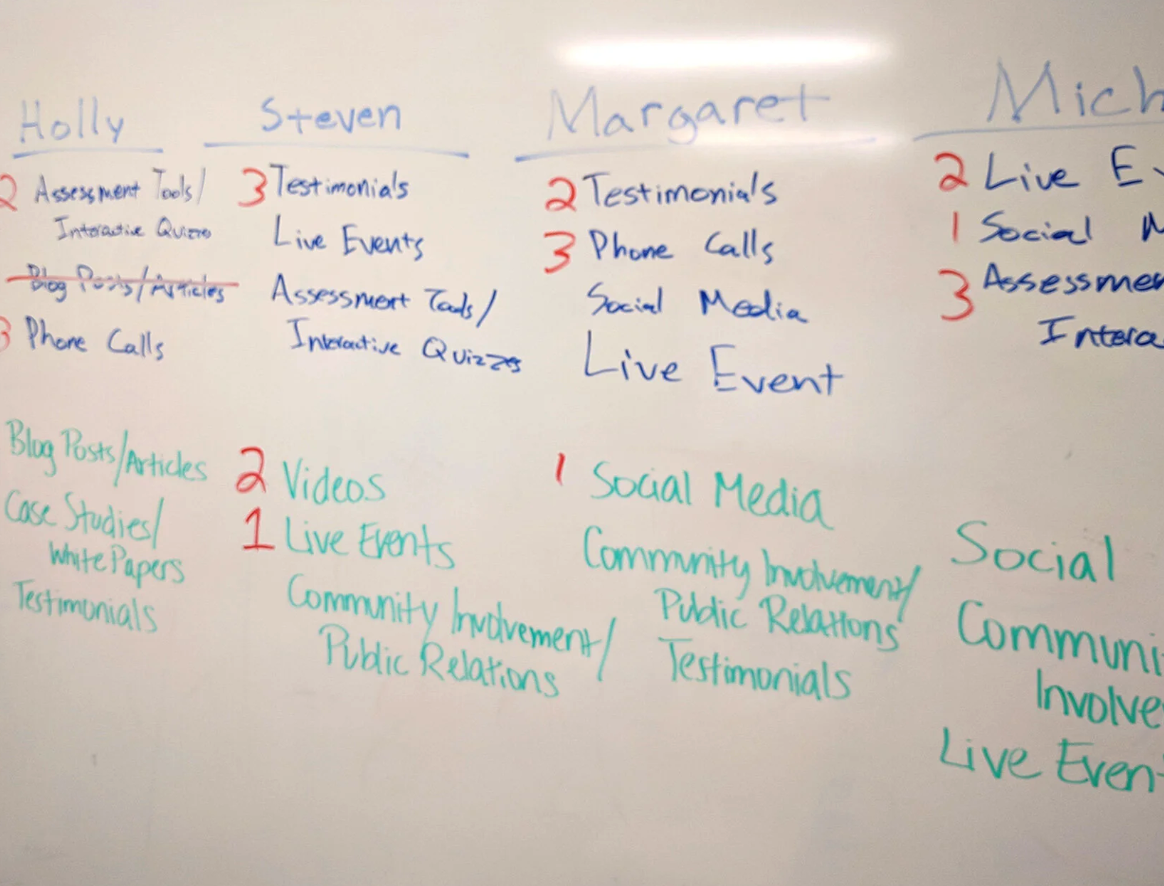
20/20 vision. The final workshop asked a direct question: how does Priority Health want to communicate with each of these people? Not how they currently communicate — how they want to. That distinction produced clear, opinionated communication priorities that went directly into the persona documentation.

Human analogy · Empathy mapping · 20/20 vision · Communication priorities
Priority Health 20/20 vision workshop — communication priorities by persona

20/20 vision — channel priorities defined for each persona, in the team's own words

The data told us who was out there. The workshops told us how to actually talk to them.

On the Priority Health engagement

03 — Outcomes and impact
5
Distinct personas developed from PRIZM segmentation data
Personas
3
Workshop formats used to build team understanding and communication strategy
Workshops
1
Unified framework deployed across all major communication channels and digital platforms
Framework

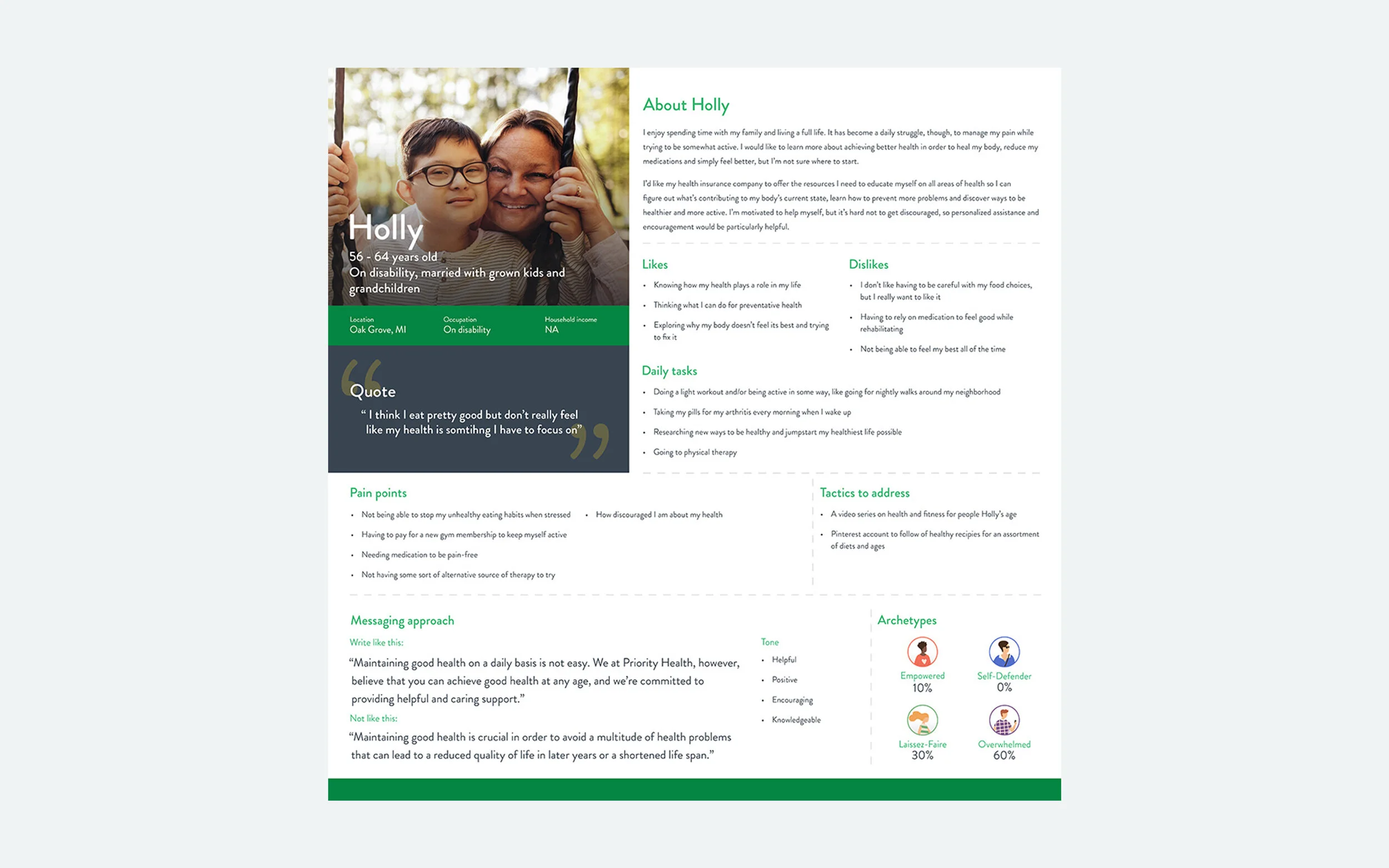
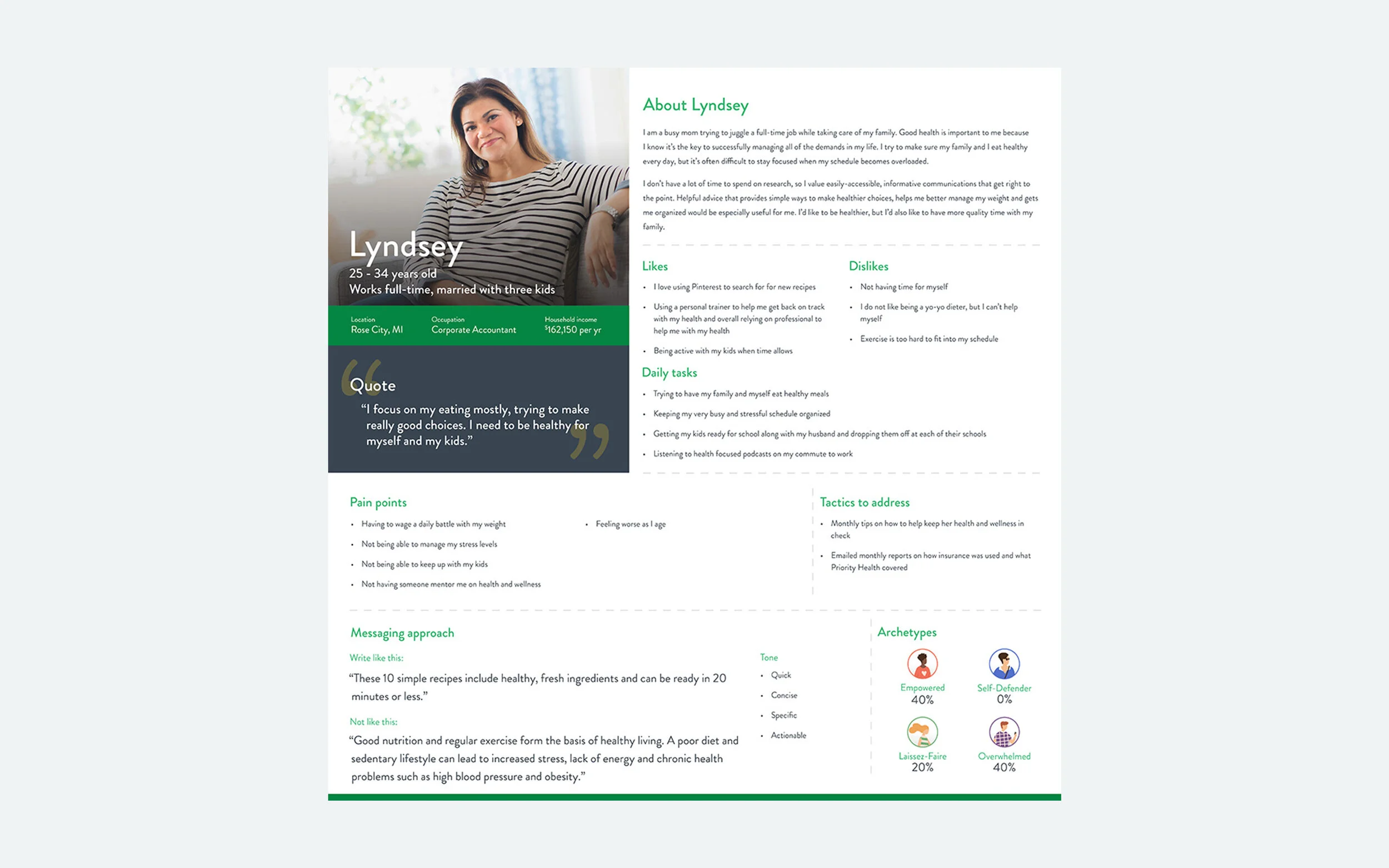
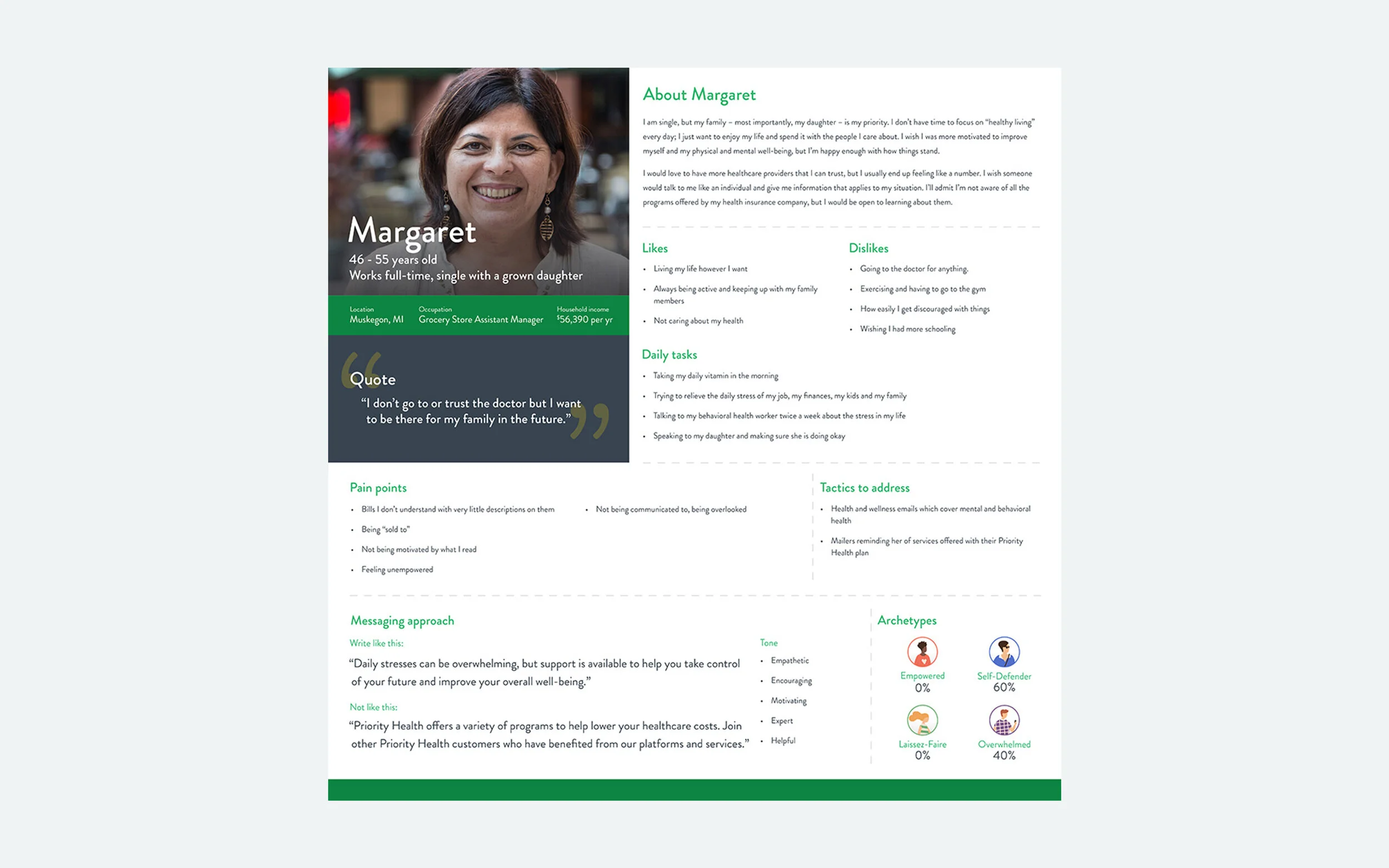
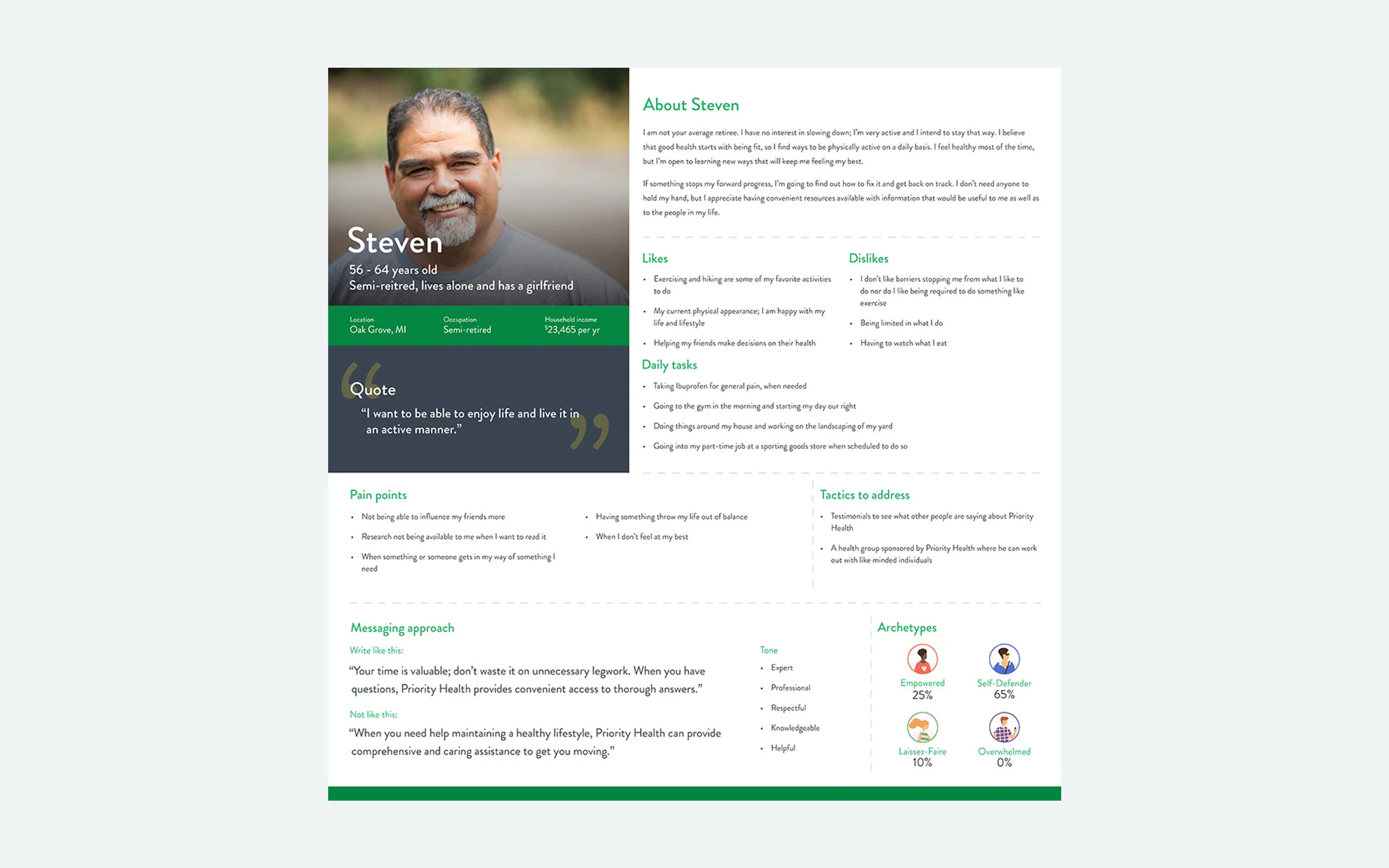
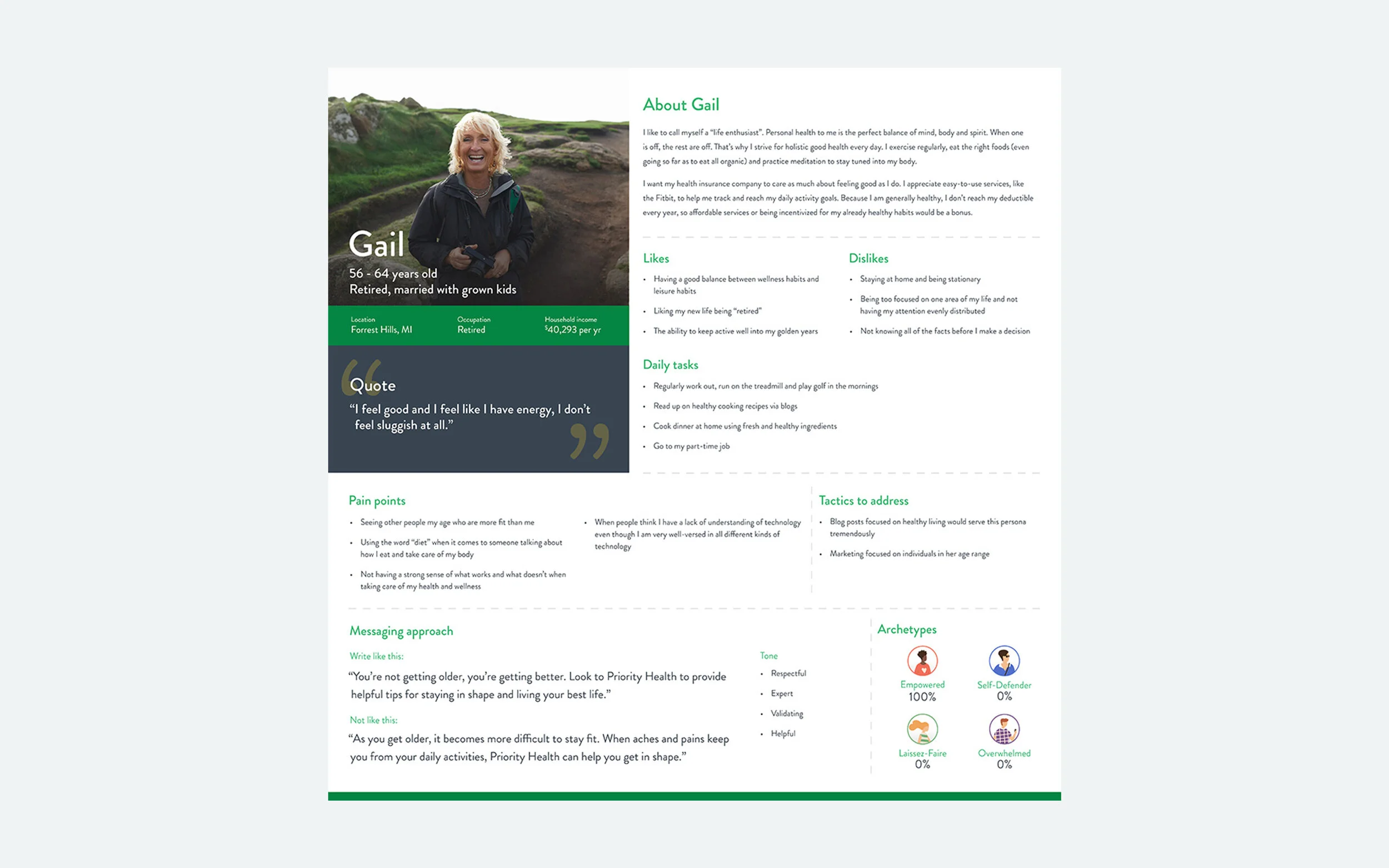
The five personas moved out of documentation and into active use — deployed across Priority Health's main communication channels and digital platforms. Each persona card included the data foundation, the empathy mapping, and the communication priorities surfaced through the workshops, giving the teams a complete picture of who they were talking to and how.

The workshop formats were the differentiating factor. The human analogy exercise, empathy mapping, and 20/20 vision sessions didn't just validate the personas — they gave Priority Health's internal teams a shared vocabulary for talking about their audience. That's what turns a persona document into something that actually gets used after the engagement ends.

The combination of rigorous data analysis and structured facilitation meant the output had credibility on both sides: grounded enough for the analysts, human enough for the communicators.

Priority Health persona — Gail
Priority Health persona — Holly
Priority Health persona — Lyndsey
Priority Health persona — Margaret
Priority Health persona — Steven
04 — The lasting thing

Five personas built from millions of data points — and a team that finally knew who they were talking to.

Related case study
Tanner Health System — 400 pages, no personas, a CMS already under contract